Will AI Replace Freelancers? What Anthropic's 2026 Workforce Data Actually Shows
By DIGGZA Team · Published · 8 min read
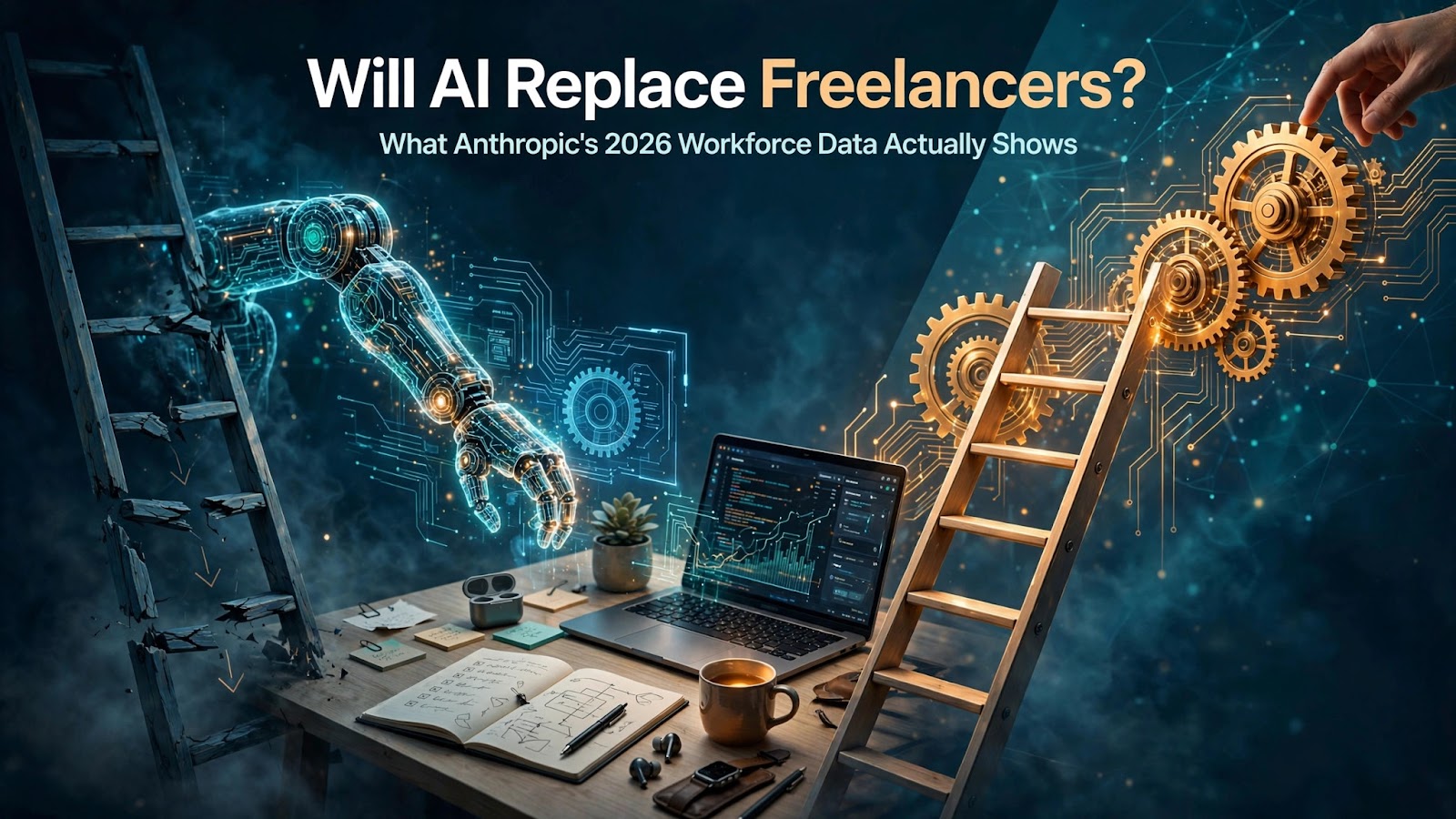
So, will AI replace freelancers? Here's the honest answer: it's already replacing junior-level freelance work — and we know this because the company building the AI just published its own numbers. On October 16, 2026, Anthropic released an internal economics report showing that the share of junior roles among its technical hires fell from 27% in early 2025 to just 9%, while interactive AI agent hours grew to six times employee hours by August 2026. If even an AI lab is quietly shrinking its junior ladder, freelance work is clearly not immune.
But that isn't the whole story. The same report shows output per person rising — more code shipped, more contracts signed — by fewer, more senior people working with agents. The opportunity now sits with freelancers who stop selling hours and start owning outcomes. Below, we break down what Anthropic's data really means for you, which freelance work is actually at risk, and five practical moves to stay hirable.
Anthropic's Own Numbers: The Report Everyone's Talking About
The report's findings were covered in dailyai.report's October 19 briefing and DEV Community's "AI Daily Digest," and have since been dissected across social media. Two figures are doing most of the talking.
Junior hiring fell from 27% to 9%
According to the report, as Anthropic scaled its internal AI agent capabilities through 2025 and 2026, the share of junior roles among technical hires collapsed from 27% (early 2025) to 9%. Overall output didn't fall — output per person actually increased. The company simply needed fewer people doing the kind of work juniors used to do, because agents were absorbing it.
This is significant because it comes from inside the machine. It isn't a think-tank projection or a vendor's marketing claim. It's a frontier AI lab documenting, in its own workforce, exactly which rung of the ladder automation climbs first.
AI agents now log 6x the hours of employees
The second headline figure: by August 2026, interactive AI agent hours at Anthropic outnumbered employee hours six to one. That means the company's most productive "workers" are no longer entirely human — they're agents operating under human direction, producing more code, sales pipeline, and contracts per human than before.
The takeaway isn't that humans became obsolete. It's that the value moved up the stack: from doing the work to directing, verifying, and taking responsibility for the work.
Why Even AI Companies Are Hiring Fewer Juniors
Agents absorb exactly the work juniors used to do
Think about what junior technical work actually consists of: routine code, first-draft copy, standard research summaries, templated designs, data cleanup. These are precisely the tasks AI agents handle well — structured, repeatable, reviewable. When a senior person with an agent can produce what used to take a junior three days, the economic case for hiring the junior weakens.
This same dynamic is hitting freelance marketplaces. A widely shared Instagram reel from October 13 showed a Fiverr seller's gig impressions collapsing from 4,000–6,000 down to 376, alongside reported active-buyer figures sliding 3.6 million (end-2024) → 3.1 million (end-2025) → 2.7 million (Q2 2026) — social-reported figures, not audited numbers, but matching the community's anxiety. A viral Facebook post on October 16 about AI displacing freelancers, virtual assistants, and designers drew 1.2K likes and 70 comments. And clients are doing something revealing — a Freelancer-branded ad spotted October 14 read "JPMORGAN IS NOW BLOCKING OUTSIDE AI AGENTS": clients are simultaneously blocking outside AI agents and replacing staff with internal ones.
What this pattern means for freelance marketplaces
Marketplaces reward the exact work most at risk: standardized, price-competed gigs. If a client can get a decent first draft from an agent in seconds, the $20 commodity gig stops making sense. But notice what isn't being replaced: the client still needs someone they trust to get the final outcome right. Verification-focused platforms — like DIGGZA's admin-verified freelancer directory — matter more in this world, not less, because verification answers the question automation can't: can I trust this person with the outcome?
Will AI Replace Freelancers? The Honest Answer
AI won't replace freelancers as a category. It is replacing a type of freelance work — and rewarding another. Here's how to think about it:
Commodity task work: high risk
Basic blog writing, simple logo templates, entry-level data entry, straightforward WordPress tweaks — anything priced by the hour and sold as interchangeable — is squarely in the agent blast radius. If your pitch is "I do the same task cheaper," agents will undercut you every time, and they already are.
Outcome and trust work: resilient
Work where the client pays for judgment, accountability, and results — audits, strategy, complex builds, systems design, crisis fixes — is much harder to automate, because someone has to own the consequences when things go wrong. Agents can't be accountable. You can.
| Task type | Risk level | Why |
|---|---|---|
| First-draft writing, basic copy | High | Agents generate acceptable drafts instantly; clients self-serve |
| Template design, simple edits | High | Commodity output, priced by the hour, easily replicated |
| Routine data entry and cleanup | High | Structured, repeatable — the textbook automation target |
| Simple coding and bug fixes | Medium–High | Anthropic's own junior-hire data shows this rung shrinking first |
| SEO audits and growth strategy | Medium | Tools assist, but judgment about trade-offs stays human |
| Custom system builds and integrations | Low–Medium | Clients need someone accountable for complex, connected work |
| Brand strategy and positioning | Low | Requires taste, context, and stakeholder trust — not automatable |
| Crisis management and turnarounds | Low | High-stakes judgment under uncertainty; ownership is the product |
5 Moves Freelancers Can Make Right Now to Stay Hirable
1. Become an "AI Owner," not an AI victim
The freelancers thriving in 2026 aren't competing with agents — they're directing them. Stop selling "10 hours of writing" and start selling "a content workflow that produces, fact-checks, and publishes." Clients don't want to manage AI themselves; they'd rather pay someone who owns the pipeline end to end.
2. Productize senior-level outcomes
Package what you do as fixed-scope outcomes: an audit with a prioritized action plan, a launch-ready store, a migration with zero downtime. Productized services are priced on value, not hours, and are far harder for a client to replicate with a chatbot. An audit report with your name on it carries accountability no agent can offer.
3. Build agent-powered services clients can't DIY
Here's the twist the Anthropic report quietly reveals: the people with the most leverage are those who build systems around agents. Offer clients automated lead-qualification pipelines, AI-assisted support setups, or research workflows wired into their business. The client could technically DIY it — but they won't, because wiring agents into a real business is genuinely hard. Sell the system, not the hours.
4. Double down on verification and trust signals
When anyone can generate plausible-looking work, trust becomes the scarcest commodity. Get verified on platforms that actually check credentials, collect detailed reviews, and publish case studies with real numbers. In a market flooded with generated output, proof of human expertise is your moat.
5. Niche down where judgment beats automation
Generalists are easiest to replace. A freelancer who understands dental-clinic marketing regulations, Shopify checkout edge cases in India, or B2B SaaS pricing psychology brings context no general-purpose agent has. Pick a niche where your judgment — built from real client scars — is the product.
The Leverage Toolkit: AI Tools That Multiply a Freelancer's Output
There's no contradiction here: the same technology shrinking junior work is the biggest leverage ever offered to independent workers. One freelancer with the right toolkit can now output like a small agency. Three tools are worth knowing about.
Cursor Pro is the AI coding assistant at the heart of move #3. A freelance developer using Cursor Pro can ship at a pace that once needed a senior team — exactly the positioning this market rewards. Instead of billing for junior-level coding hours (the rung that's shrinking), you deliver finished, reviewed systems.
n8n Starter is a workflow automation platform — the natural engine for the "AI Owner" model. With n8n Starter, you can build the automated pipelines you sell to clients — lead qualification, content workflows, support triage — turning one-off gigs into systems clients keep paying for.
Gemini AI Pro is the everyday leverage layer. Research, drafting, brainstorming, quick analysis — Gemini AI Pro compresses the slow parts of knowledge work so a single freelancer can take on the workload of a small team without burning out. It's the quiet multiplier behind moves #1 and #2.
The pattern is simple: pick tools that move you up the value stack, toward ownership and outcomes — not tools that just help you do commodity work slightly faster. The former is a career moat; the latter is a race to the bottom you can't win against agents.
FAQ
Will AI replace all freelance jobs?
No — and Anthropic's own report is the evidence. Even as agents took on six times the human hours, output per person rose and the company kept hiring: it just hired differently, favoring people who direct and verify rather than execute routine tasks. Freelancing follows the same split: commodity execution shrinks, while outcome ownership and judgment stay human.
Should I quit freelancing in 2026?
If your entire income comes from interchangeable hourly tasks, treat this as a serious warning, not a death sentence. The freelancers adapting now — building agent-powered services, productizing outcomes, niching down — are strengthening their positioning. Quitting is the wrong lesson; repositioning is the right one.
What skills should freelancers learn now?
Three clusters matter most: (1) agent orchestration — building and managing AI workflows, not just prompting; (2) verification and quality control — fact-checking and taking accountability for AI-assisted output; and (3) domain depth — real expertise in a specific industry or problem type, where your judgment is the product.
Is it too late to start freelancing?
It's too late to start as a 2021-style generalist selling hours. But it's arguably the best time to start as an AI-native specialist: no legacy habits to unlearn, and clients actively want people who can build them agent-powered systems. Start with a narrow, outcome-based offer — not a broad "I do everything" profile.
Conclusion
The junior ladder is breaking — Anthropic's own workforce data, from 27% junior hires down to 9% while agents log six times human hours, says so plainly. But a second ladder is being built at the same time: the "AI Owner" ladder, for people who direct agents, guarantee outcomes, and carry accountability no model can.
Your next step is concrete: pick one move above and start this week. Audit which of your services sit in the high-risk rows of the table, and redesign one as an outcome-based, agent-powered offer. The freelancers making that shift aren't just surviving AI — they're being amplified by it.
AI and freelancingfreelance survival guideAI agentsAnthropic report 2026freelance market trendsstaying relevant
Related articles

How Freelancers Can Adapt to AI: A Practical Guide for 2026
AI is shifting freelance demand across Asia — but the data shows a clear path forward. Here's how freelancers can adapt to AI in 2026 with the skills clients are actually hiring for.
DIGGZA Team ·

How to Get Freelance Clients in 2026: Why Trust Beats Cheap in the AI-Sorted Marketplace
In 2026, marketplaces are quietly splitting: cheap commodity gigs are vanishing into AI tools, while trusted specialists earn more than ever. Here is how to land on the winning side.
DIGGZA Team ·
AI Agents Are Here: What Gemini's Auto-Browse Means for Freelancers in India
AI is no longer just answering questions — it has started doing tasks. Google's Gemini Auto-Browse is live in India, and freelancers who understand AI agents early will have a real edge.
Ben Thompson ·