How to Sell AI Cleanup Services as a Freelancer in 2026
By DIGGZA Team · Published · 8 min read
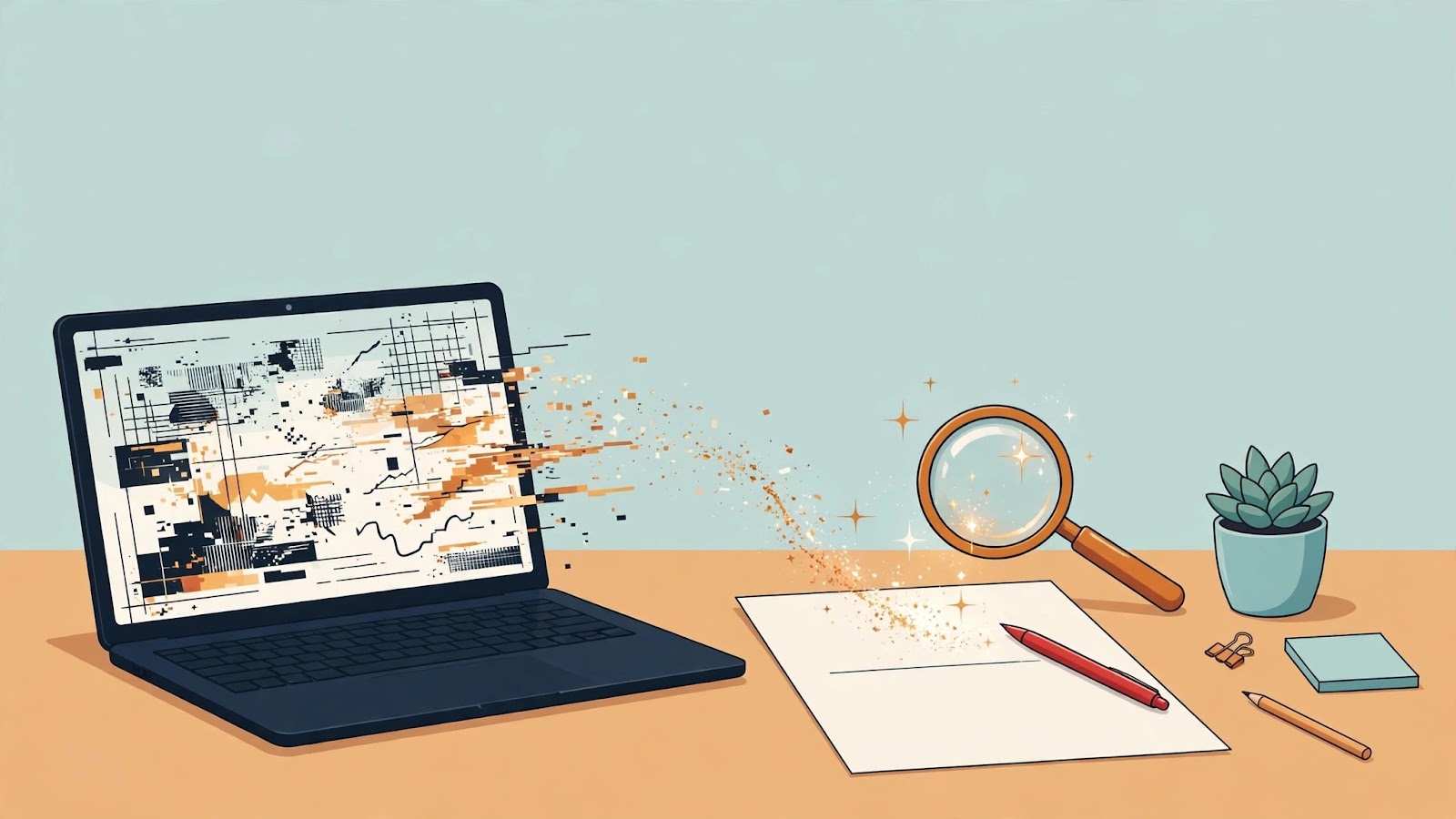
A client recently showed me a blog post their AI tool had written in under a minute. It read well — until the third paragraph, where it quoted a statistic from a study that does not exist, and a fifth recommending a product the company had discontinued two years ago. The draft was free. Fixing it was the paid job.
That is the opportunity behind AI cleanup services. Businesses now generate enormous volumes of text, code, data and media with AI tools, and then discover the same thing every careful reader discovers: AI output still needs a human last mile. Someone has to check the facts, repair the code, correct the proportions, fix the tone and make the whole thing safe to publish. If you are a freelancer, that someone can be you. Here is how to sell AI cleanup services, what to charge, and how to find your first clients.
What "AI cleanup" work actually is (and why clients suddenly need it)
AI cleanup is not proofreading with a trendier name. Proofreading catches typos. Cleanup catches everything an AI tool gets plausibly wrong: invented facts, broken logic, inconsistent terminology, off-brand tone, code that runs only sometimes, and translations that read like a machine wrote them. The client is not buying corrections. They are buying confidence that the output can go live.
The last-mile problem: AI drafts, humans own quality
AI tools are excellent at producing a first draft and unreliable at judging it. They do not know your client's brand voice, their legal exposure, or whether a claim is true — they know what sounds likely. That gap is the last-mile problem, and it grows every time models get cheaper and faster. Late-October 2026 reporting describes exactly this shift: companies are hiring freelancers in growing numbers to fix AI-generated output, moving the freelancer's role from "maker" to "validator" — the person who checks, polishes, verifies facts, aligns tone and keeps brand consistency intact. (Digital Nomad Press, "Is AI Bringing More Freelance Work?")
The 5 cleanup job types
- Content cleanup: fact-checking, fixing invented citations, tightening structure, and aligning AI-written articles, product descriptions and emails with a brand's voice.
- Code repair: reviewing AI-generated code, fixing bugs, adding tests, and normalising style so it survives a real production environment.
- Data verification: checking AI-compiled spreadsheets, summaries and reports against their original sources before anyone makes a decision from them.
- Design fixes: correcting proportions, text errors, inconsistent branding and layout problems in AI-generated graphics and mockups.
- Audio/video polish: editing AI-generated voiceovers, transcripts and video drafts — removing robotic pacing, mispronunciations and awkward cuts.
Why AI cleanup is a real opportunity in late 2026
Two forces are pushing in the same direction. On the supply side, AI output keeps getting cheaper: OpenAI's GPT-6.1 Terra launched on 26 October 2026 at half the price of its predecessor, and Anthropic's Claude Haiku 5.5 launched on 7 October 2026 at roughly a tenth of the previous Haiku's price. Cheaper models mean more AI-generated output in circulation — and every extra draft is a future cleanup job.
On the demand side, marketplaces are re-sorting what clients buy. Fiverr's Q3 2026 earnings call on 29 October 2026 showed buyers moving away from low-cost transactional gigs toward more complex engagements, with first-time buyer volume sourced through AI channels up 64% quarter-over-quarter, according to PYMNTS' reporting of the call. (PYMNTS, "Fiverr Pivots to AI Agents as Traditional Search Erodes") Clients are not buying less freelance work — they are buying different freelance work, and verification is at the top of the list.
The practical result: a service category that barely had a name a year ago is now something clients recognise and budget for.
5 AI cleanup services you can sell this month
Do not sell "AI cleanup" in the abstract. Sell a named service with a clear deliverable:
- AI article rescue. A marketing agency hands you ten AI-written blog posts. You return them fact-checked, with invented statistics removed or replaced with sourced ones, headings restructured, and tone matched to their style guide. Deliverable: publish-ready articles plus a short list of every claim you corrected.
- AI code review and repair. A startup's developer used an AI assistant to scaffold a feature. You fix the failing edge cases, add tests, and document what changed. Deliverable: a working pull request with a plain-English summary of the fixes.
- AI report verification. A consultancy's AI tool summarised fifty pages of research into a client deck. You check every number against the originals and flag anything the summary invented or misread. Deliverable: a verified deck plus a corrections log.
- AI design correction. An e-commerce seller generated product graphics with an AI tool, but the text on the images is misspelled and the brand colours are wrong. You fix the artwork and export it in the right formats. Deliverable: corrected, print- and web-ready files.
- AI audio and video polish. A course creator generated a voiceover and rough video edits with AI. You remove robotic pacing, fix mispronunciations, tighten the cuts and balance the audio. Deliverable: a finished video that sounds like a human made it.
Start with the one closest to skills you already have — depth in one cleanup type beats a vague promise to fix everything.
How to price AI cleanup work
Price per piece, not per hour, whenever you can. Clients want a predictable cost for a predictable deliverable — "₹X per article" beats an open-ended hourly rate, and hourly pricing punishes you for getting faster.
| Pricing model | When it works | Watch out for |
|---|---|---|
| Per piece (per article, per video, per file) | Repeatable deliverables with clear scope | Define what counts as one "piece" before you start |
| Hourly | Messy, open-ended jobs where scope is genuinely unknown | Clients may question the hours; track your time visibly |
| Monthly retainer | Clients with a steady stream of AI output | Cap the volume included, or scope creep eats your margin |
A practical starting structure: a per-piece rate for the first job, then a retainer once a client sends regular work — a fixed monthly fee covering a set number of pieces, with extras at the same per-piece rate.
Price on the value of a publish-ready result, not on the cost of the draft: the tool was cheap; your judgment is the product.
How to package and pitch it
Clients buy cleanup because they have been embarrassed by AI output at least once — a wrong fact in a client email, a broken demo, a video that sounded robotic. Your pitch should speak to that moment.
- Name the pain, not the process. "I make your AI-written content safe to publish" beats "I offer AI output editing services." Lead with the outcome.
- Show before-and-after samples. Take a flawed AI draft, mark its errors, then show your corrected version. One strong before-and-after beats a page of claims.
- State a revision policy. Cleanup clients worry about endless back-and-forth. Promise one round of revisions included, and charge for more. It signals professionalism and protects your time.
- Lead with trust. Cleanup work means handling a client's unpublished drafts, internal data and brand reputation. A verified profile on a directory like DIGGZA gives a new client a reason to trust you before the first job; testimonials from your first cleanup clients do the rest.
A simple pitch template: "You already use AI to draft [content/code/reports]. I check, correct and polish that output so it is accurate, on-brand and ready to publish — at a fixed price per piece, with one revision included." Short, concrete, and easy to say yes to.
Tools that make cleanup faster
Cleanup is human judgment work, but the right tools speed up the mechanical parts. Three fit naturally into a cleanup workflow:
- For code repair: Cursor Pro is an AI-assisted coding environment for reviewing AI-generated code, spotting failing logic, and rewriting it with proper tests.
- For audio and video polish: Descript Creator lets you edit audio and video by editing text, making AI voiceover and transcript fixes far faster than scrubbing timelines by hand.
- For drafting fixes and fact-checking passes: Gemini AI Pro works as a second pair of eyes — drafting corrected passages and running checking passes you verify before anything reaches the client.
The rule with all three: the tool assists, you decide. Your final check is always human.
Mistakes to avoid
- Taking raw-output volume work at race-to-bottom rates. If a client wants a thousand AI articles "lightly cleaned" for pennies each, that is a volume trap, not cleanup. Decline it or re-scope it.
- Promising to "fix everything." Some AI output is beyond repair — a report built on invented sources, or code with a fundamentally wrong architecture. Say so honestly, and offer to rebuild rather than patch. Clients respect the honesty, and it protects your reputation.
- Skipping source checks. The most dangerous AI errors are the plausible ones. Every statistic, quote, date and product claim gets checked against its source, or flagged as unverified. No exceptions, even when the draft "looks fine."
FAQ
Is AI cleanup just proofreading?
No. Proofreading catches surface errors — spelling, grammar, punctuation. AI cleanup catches deeper problems: invented facts, broken code logic, misread data, off-brand tone and design errors. It requires judgment about what is true and what fits, not just what reads correctly.
Do I need coding skills to sell AI cleanup?
Only for code repair. Content cleanup needs language and research skills; design fixes need design skills; audio polish needs editing skills. Pick the type matching what you already do well.
Will this work disappear as AI models improve?
Models will keep improving, but so will the volume of AI output — and every new capability creates new kinds of errors to catch. The need for a human last mile does not disappear, because clients, not models, carry the reputational risk of publishing something wrong.
How do I find my first cleanup clients?
Start where AI output already exists: agencies publishing AI-assisted content, startups shipping AI-assisted code, and course creators using AI voiceovers. Offer a free one-piece sample cleanup to two or three prospects, and publish the before-and-after (with permission) on your verified freelancer profile.
Conclusion — a practical next step
AI cleanup is not a trend to watch; it is a service to sell. The demand is already visible — cheaper models producing more output, marketplaces re-sorting toward complex work, and clients learning the hard way that a draft is not a deliverable.
Your next step is simple: pick one cleanup type, create one before-and-after sample this week, and add "AI cleanup" to your freelancer profile. One sample, one listing, one pitch — that is how a new income stream starts.
AI cleanup servicesfreelancingAI toolsfreelance pricingclient acquisition
Related articles

AI Agent Governance Services: How Freelancers Can Sell Agent Audits and Oversight in 2026
India's biggest IT firms are now selling "policing" for AI agents. Here is how freelancers can package the same oversight — audits, guardrails and monitoring — as a service small businesses can actually buy.
DIGGZA Team ·

How to Get Paid Filming Everyday Tasks for AI Robots: A Freelancer's Guide to Robot-Training Gigs (2026)
Ordinary work — cutting hair, cooking, folding laundry — is now paid AI-training work. Here is how robot-training gigs work, what they pay, and how to start safely.
DIGGZA Team ·

AI Shopping Agents Are Here: How Freelancers Can Get Found When Machines Do the Buying
Walmart just opened its doors to AI shopping agents while Amazon shut them. For freelancers, the message is clear: soon the first person to judge your offer may not be a person at all — here's how to be ready.
DIGGZA Team ·